
Submission and Application Forms
Awards Nomination Form
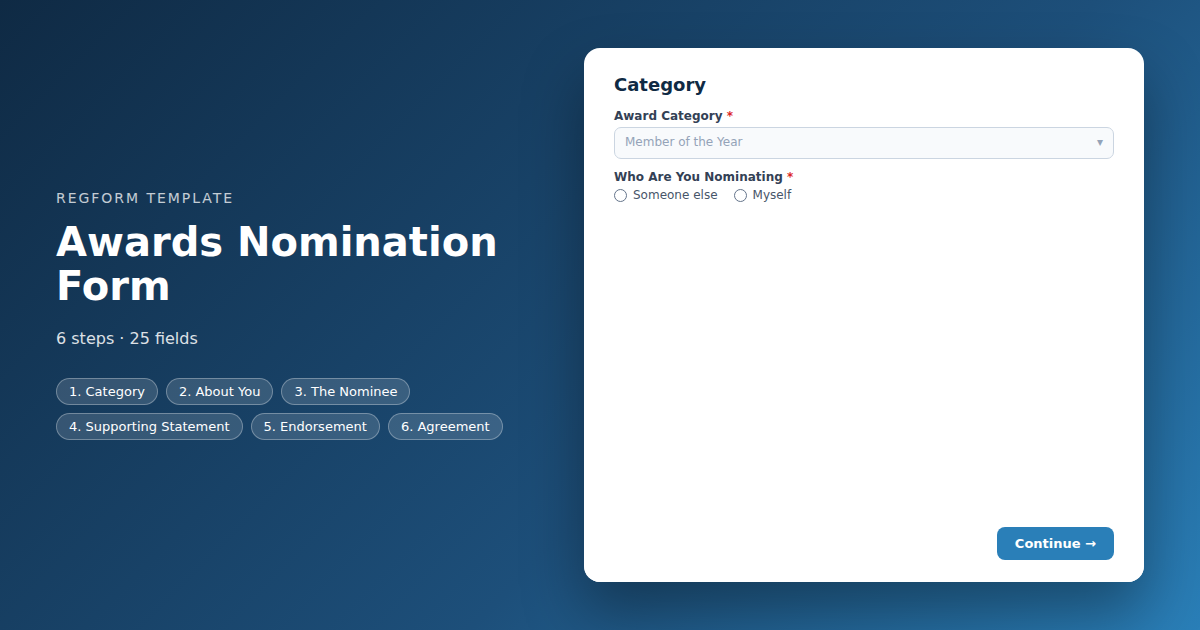
Puts the category criteria where nominators actually read them. Separate paths for self and third party nominations, conditional endorsements, and statements a committee can compare.
Overview
Award programmes fail in two places. Nominations land in the wrong category because nobody read the criteria, and the supporting statements vary so wildly in length and shape that the committee cannot compare them against each other. Both are form problems before they are process problems, and both are fixable at the point of submission rather than during review.
What this form does
It puts the criteria where the nominator is actually looking, which is the form itself rather than the prospectus they skimmed a month ago. It asks a different set of questions depending on whether somebody is nominating themselves or another person, since those are genuinely different situations. And it requests endorsements only for the categories that require them, rather than imposing that cost on every entry. What comes out is a set of nominations a committee can read side by side and score consistently.
Who it is for
Associations and industry bodies running annual awards, professional societies with fellowships or honours programmes, and conference organizers with a recognition scheme attached to the event. It assumes a review committee exists and that somebody has to compare entries rather than simply collect them.
How to adapt it
The category list is the whole job. Give each one a description of what it actually rewards, decide whether self nomination is permitted, and set the supporting statement limit at something your committee can realistically read thirty of in an evening. Everything else on the form is contact collection and can be trimmed freely.
Form field list
Category
| Field | Type | Required | Notes |
|---|---|---|---|
| text_block | text_block |
Optional | — |
| Award Category | dropdown |
Required | — |
| Who Are You Nominating | radio |
Required | — |
About You
| Field | Type | Required | Notes |
|---|---|---|---|
| Your First Name | text |
Required | — |
| Your Last Name | text |
Required | — |
| Your Email Address | email |
Required | — |
| Your Phone | phone |
Optional | — |
| Your Organization | text |
Optional | — |
| Your Relationship to the Nominee | text |
Optional | — |
The Nominee
| Field | Type | Required | Notes |
|---|---|---|---|
| text_block | text_block |
Optional | — |
| Nominee Full Name | text |
Optional | — |
| Nominee Email Address | email |
Optional | — |
| Nominee Organization | text |
Optional | — |
| Job Title or Role | text |
Optional | — |
| Years Active in the Profession | dropdown |
Optional | — |
Supporting Statement
| Field | Type | Required | Notes |
|---|---|---|---|
| Supporting Statement | textarea |
Required | — |
| Suggested Citation | text |
Optional | — |
| Supporting Links | textarea |
Optional | — |
Endorsement
| Field | Type | Required | Notes |
|---|---|---|---|
| text_block | text_block |
Optional | — |
| Endorser Name | text |
Optional | — |
| Endorser Email | email |
Optional | — |
| Endorser Organization | text |
Optional | — |
Agreement
| Field | Type | Required | Notes |
|---|---|---|---|
| Nomination Terms | legal |
Required | — |
| Everything in this nomination is accurate to the best of my knowledge | checkbox |
Required | — |
| You may tell the nominee that I nominated them | checkbox |
Optional | — |
How it's built in Regform
Setup checklist
- Write the criteria into the form, not just the call. Each category should carry a one line description of what it rewards. Nominators read the form, not the prospectus, and a nomination submitted into the wrong category wastes both their effort and your reviewers'.
- Decide whether self nomination is allowed. The form asks, and reveals a different set of questions depending on the answer. Many programmes forbid it outright. Say so in the category description if yours does, rather than rejecting submissions afterwards.
- Keep the supporting statement bounded. Reviewers read dozens of these. A stated word limit makes them comparable, though nothing enforces it, so be explicit that over length entries may be returned.
- Ask for a second endorsement only where it matters. The template reveals an endorser section for categories that need one. Requiring two endorsements on every category is the fastest way to halve your submission count.
- Route submissions to the review committee. Nominations sit pending until a reviewer decides. Decide before launch whether reviewers see nominator identities, since that shapes what you show them and it is hard to change mid cycle.
- Close on the deadline. Nominations arrive in the final two days, as reliably as abstracts do. Set the cutoff and decide what the page says afterwards.
Before you publish
Submit once as a self nomination and once on behalf of somebody else, and confirm the question sets differ correctly. Submit into a category that requires an endorsement and check that section appears. Then read the confirmation as a nominator would and ask whether it says when decisions land.
Frequently asked questions
Can people nominate themselves?
The form asks whether the nominator is nominating themselves, and the questions change accordingly. A third party nomination collects the nominee's contact details and the nominator's relationship to them, while a self nomination skips both. If your programme forbids self nomination, remove the option and say so in the category descriptions.
How do I stop nominations landing in the wrong category?
Put a one line description of the criteria next to each category name in the dropdown. Nominators read the form rather than the prospectus, and a nomination filed into the wrong category wastes the nominator's effort and a reviewer's time. This is the single highest value edit you can make to this template.
Should I require a second endorsement?
Only for the categories that genuinely need one. The template reveals an endorser section conditionally rather than asking everybody. Requiring two endorsements across every category is a reliable way to halve your submission count, because the nominator then has to chase somebody else before they can finish.
How long should the supporting statement be?
State a word limit in the label and be explicit that over length entries may be returned. Nothing in the platform enforces it, since there is no maximum length on a long text field. Reviewers comparing thirty nominations need them to be roughly the same size, so the limit matters even though it is advisory.
What about supporting documents?
Collect links rather than attachments. The template format cannot carry a file upload field, though Regform itself supports uploads and you can add one in the builder after importing. For most award programmes a link to published work or a portfolio is sufficient at nomination stage, with documents requested only from shortlisted candidates.
How does review work?
Each nomination is held pending until a reviewer decides. Decide before launch whether your committee sees nominator identities or reviews blind, because it changes what you display and is difficult to alter once nominations are in flight. Blind review is more defensible for anything where the nominator has standing in your organization.
Should the nominee know they have been nominated?
Tell the nominee, with the nominator's knowledge. Most programmes notify nominees once a nomination is validated, both as a courtesy and because the nominee often has to supply something. The form collects nominee contact details for exactly this, so decide the timing and put it in the confirmation email.
Browse related categories
Form type: Submission and Application Forms
Use cases: Awards and Nominations
Capabilities: Approval Workflow Conditional Logic Confirmation Email
Ready to launch your awards nomination form?
Tell us about your event and we'll set this template up with you — fields, logic, payments, and all.
- Multi-step forms & conditional logic
- Built-in checkout, payments & invoicing
- Event registration, reporting & team roles
Use This Template
We'll reach out and get you building.
Download template (JSON)Import the file with the builder's Import button in your own account.
Already have an account? Sign in